

Spring and Fall
Oct 5 - Nov 12, 2016
Mennour, 51 Brook Street, London
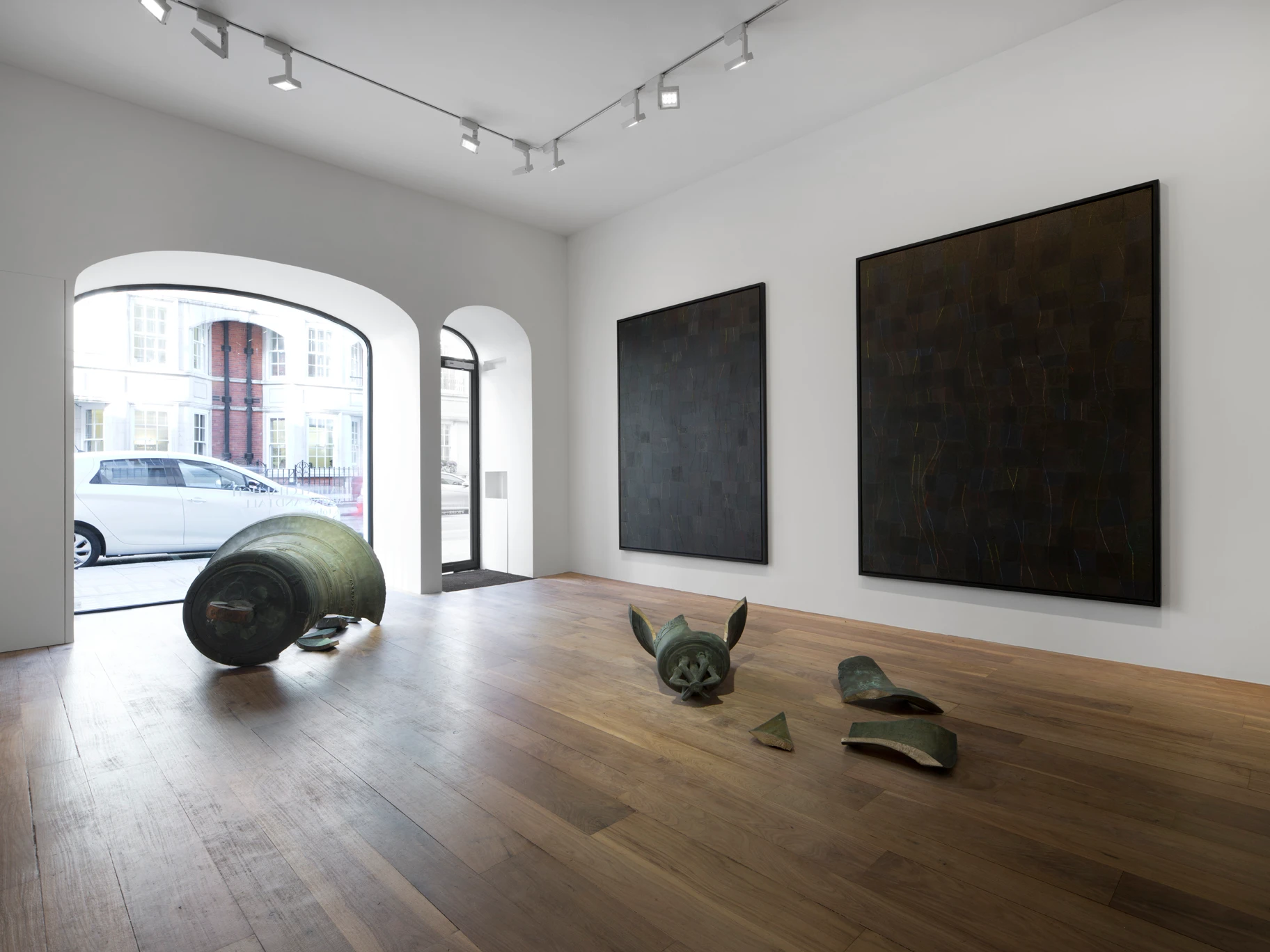
Giant bronze bells lie shattered across the floor. On the wall hang large canvases blackened in ink, the sediment of their childish colours appearing in naïve graffiti. For the inauguration of his new London space during Frieze, Kamel Mennour is pleased to present a series of new works by Latifa Echakhch.
The French-Moroccan artist brings together the eddies of world history with the gestures of childhood. From the encounter, she redraws unknown contours: ‘Elsewhere… I want to live in this place where the gap between the functionality of a time, a thing, and where they have gone opens up infinite potentialities. Ruins speak to me. Not because they have gone under, but because of the paths they initiate.’
The bells have smashed to pieces in a final peal, deafening though forever lacking. Their silence reverberates through future time. A time when a chorus of voices will lift up from the monumental debris to ‘free the heavens’ 1. One can hear the voice of Zarathustra: ‘Free from the happiness of serfs, redeemed from gods and worship, fearless and fearful, great and solitary, that is how the will of the genuine man is.’ 2 The voice of the French Revolution and the fledgling Republic’s laws for desacralising the soundscape are evoked 3. One hears, vibrating, the Romantic palpitations of hearts’ osmosis… An inaugural season, like childhood is.
Time’s lines transcribe strata of memory and forgetting in black ink. But behind appearances, nothing is effaced. The scribbles and joys of childhood are ready to break through the surface of the present. Latifa Echakhch has their ample movements appear intermittently in colourful crayon lines, the containers of our first, singular and universal emotions. Walter Benjamin once wrote: ‘the child’s apprehension of colour brings the sense of sight to its highest artistic development […] insofar as it isolates that sense. It elevates this development to a spiritual level.’ 4.
At once above and below boundaries and forms, Latifa Echakhch performs gestures of flight, even as places in which to stand firm. Paul Celan would leave the mark of his own thunderbolt there:
'From the visible, from the audible, the turning
free wordtent: Together' 5
— Annabelle Gugnon
1. Paul Celan, Die Niemandsrose, 1963.
2. Friedrich Nietzsche, Thus Spoke Zarathustra, Trans. R. J. Hollingdale, 1974.
3. Alain Corbin, Les Cloches de la terre, Ed. Albin Michel, 1994.
4. Walter Benjamin, A Child’s View of Color, Trans. Rodney Livingstone, in Selected Writings, Ed. Marcus Bullock and Michael W. Jennings, Vol. 1, 1913-1926, 1996.
5. Paul Celan, ‘Anabasis’, in Die Niemandsrose.