



Illuminations
Nov 28, 2019 - Jan 18, 2020
Mennour, 47 rue Saint-André-des-Arts
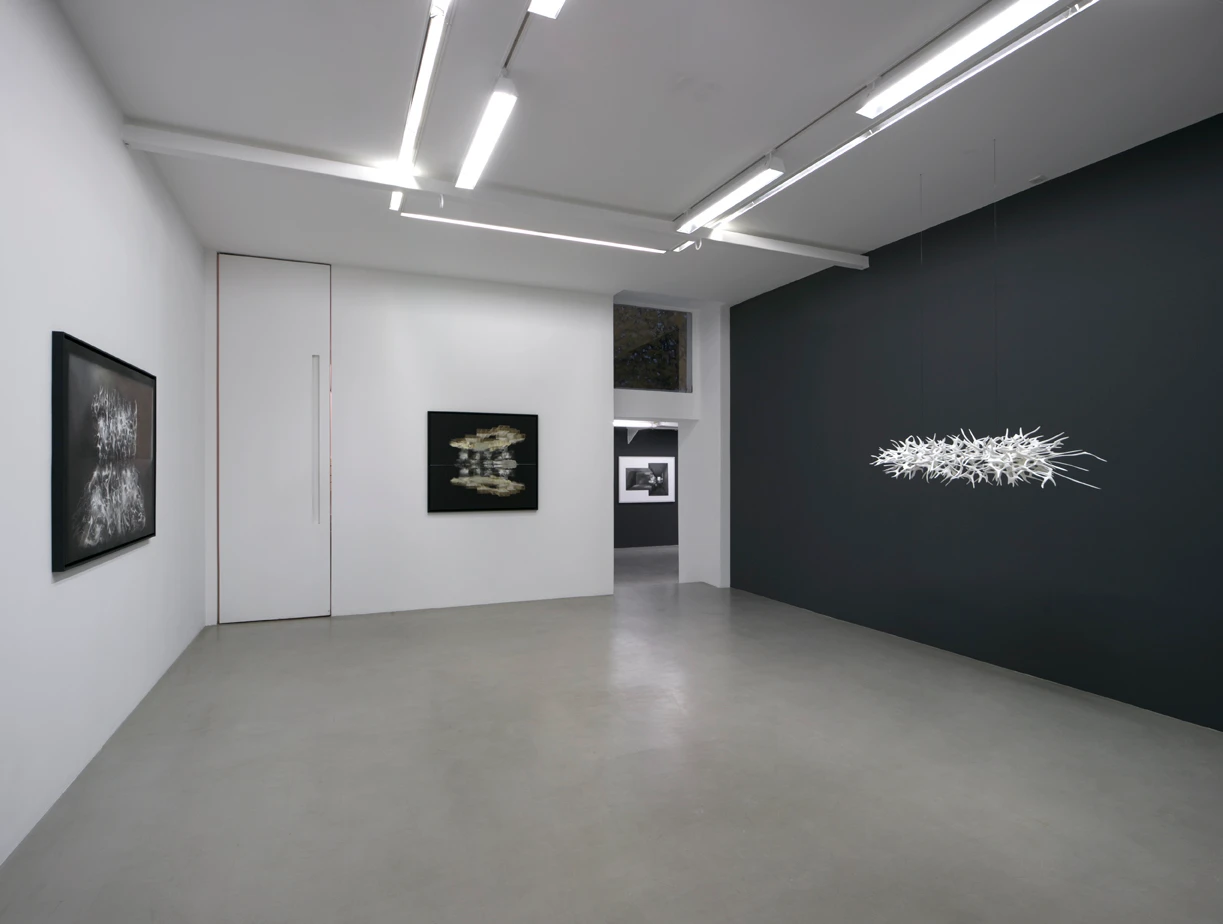
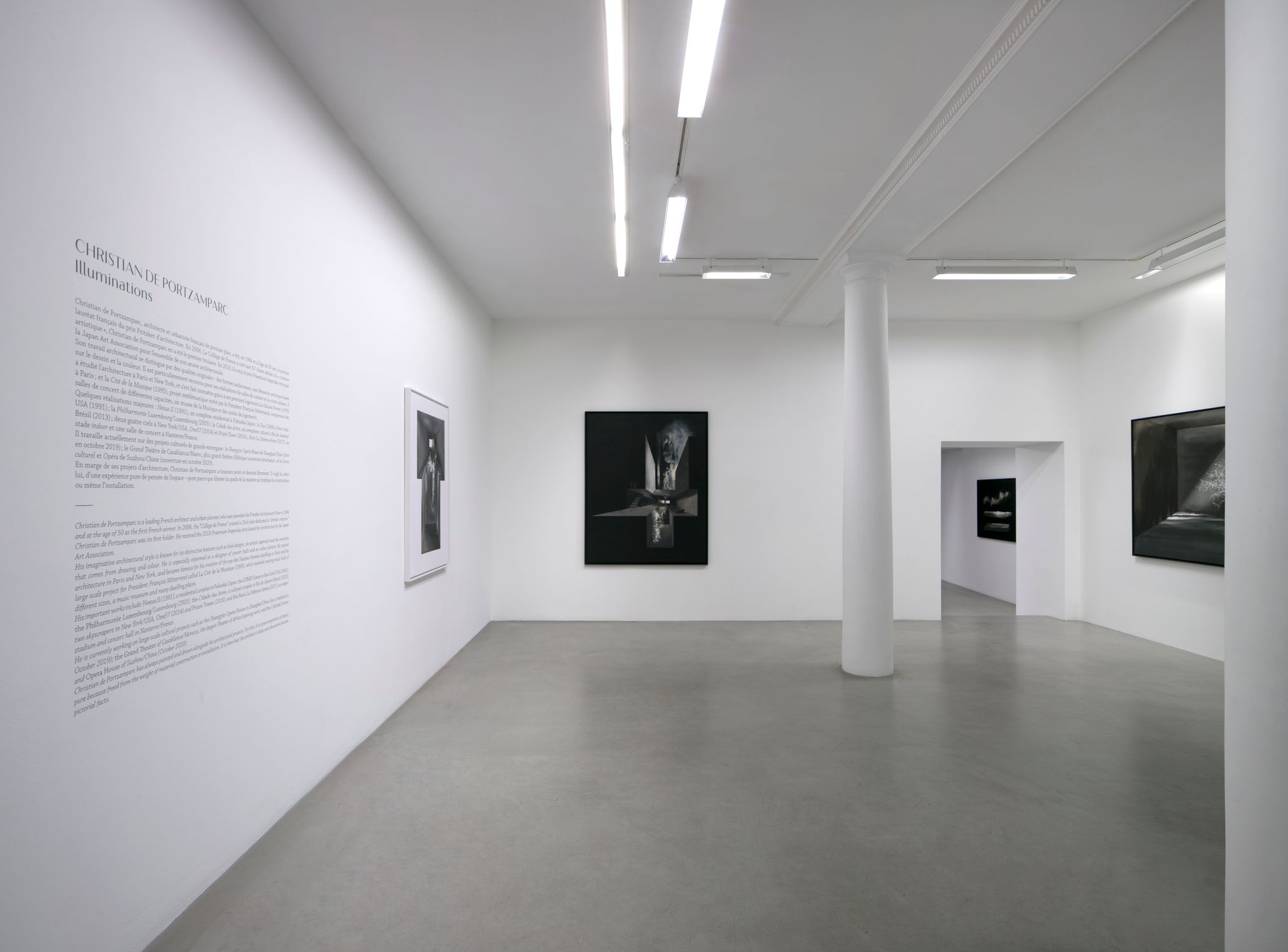
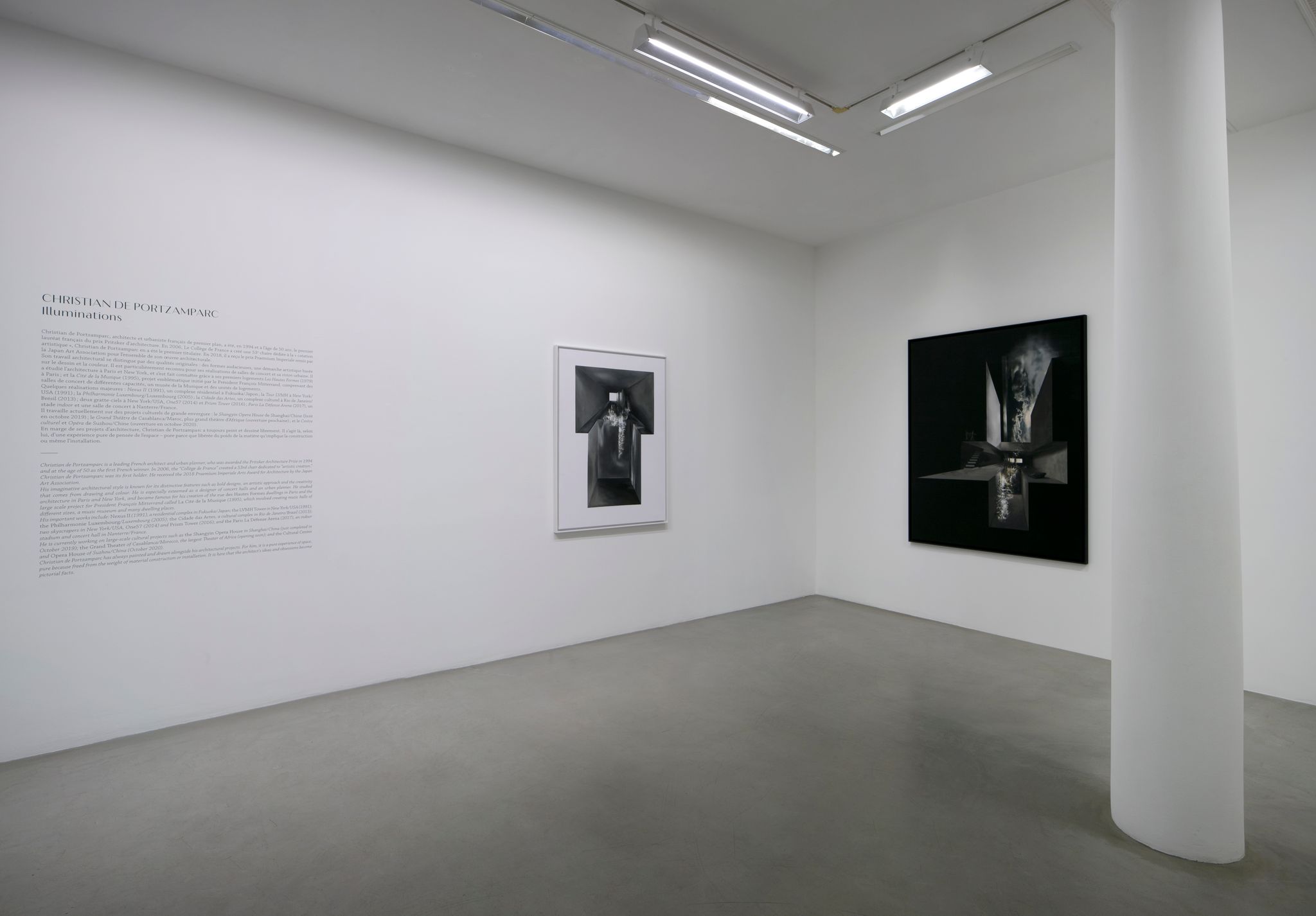
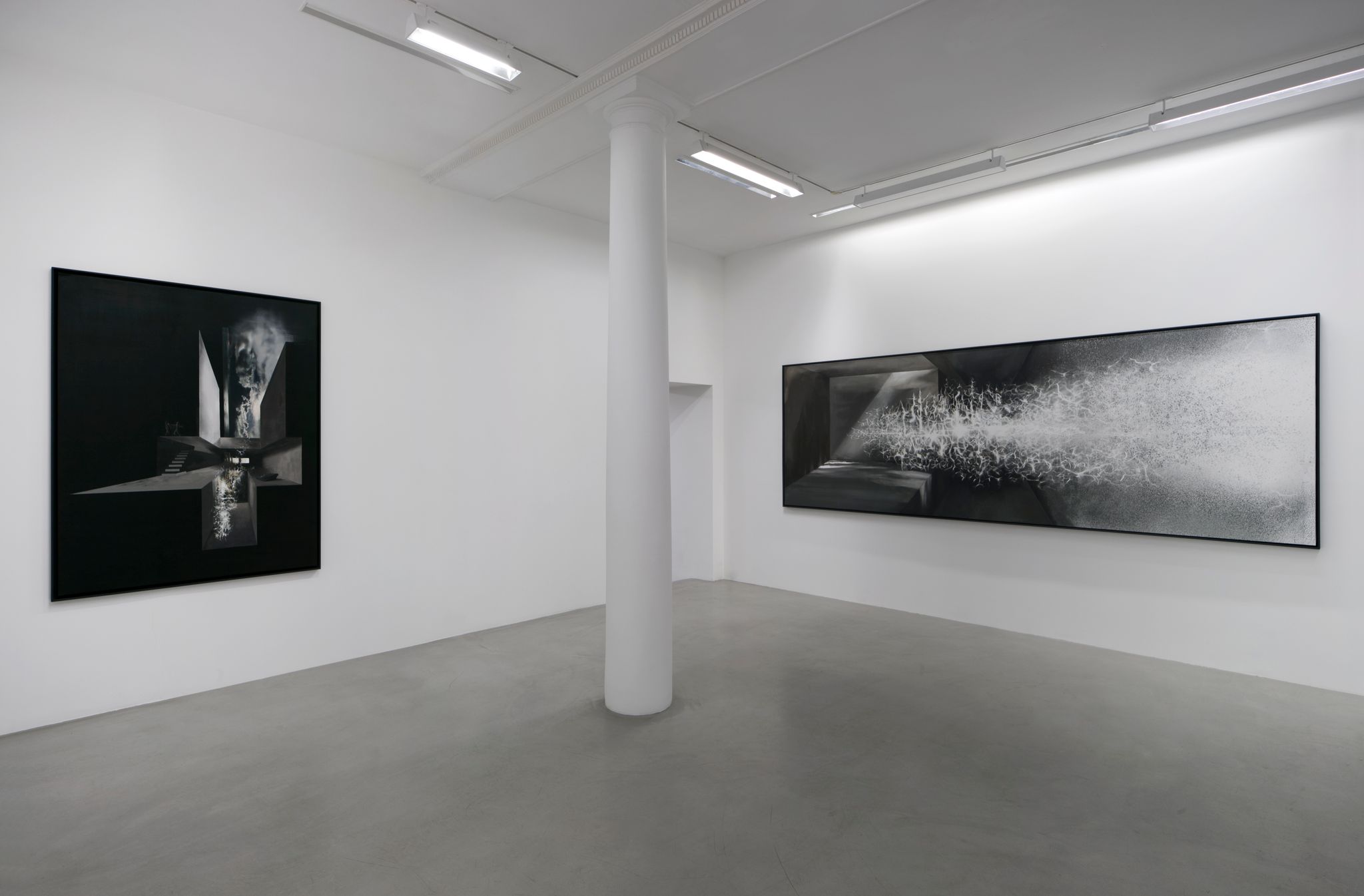
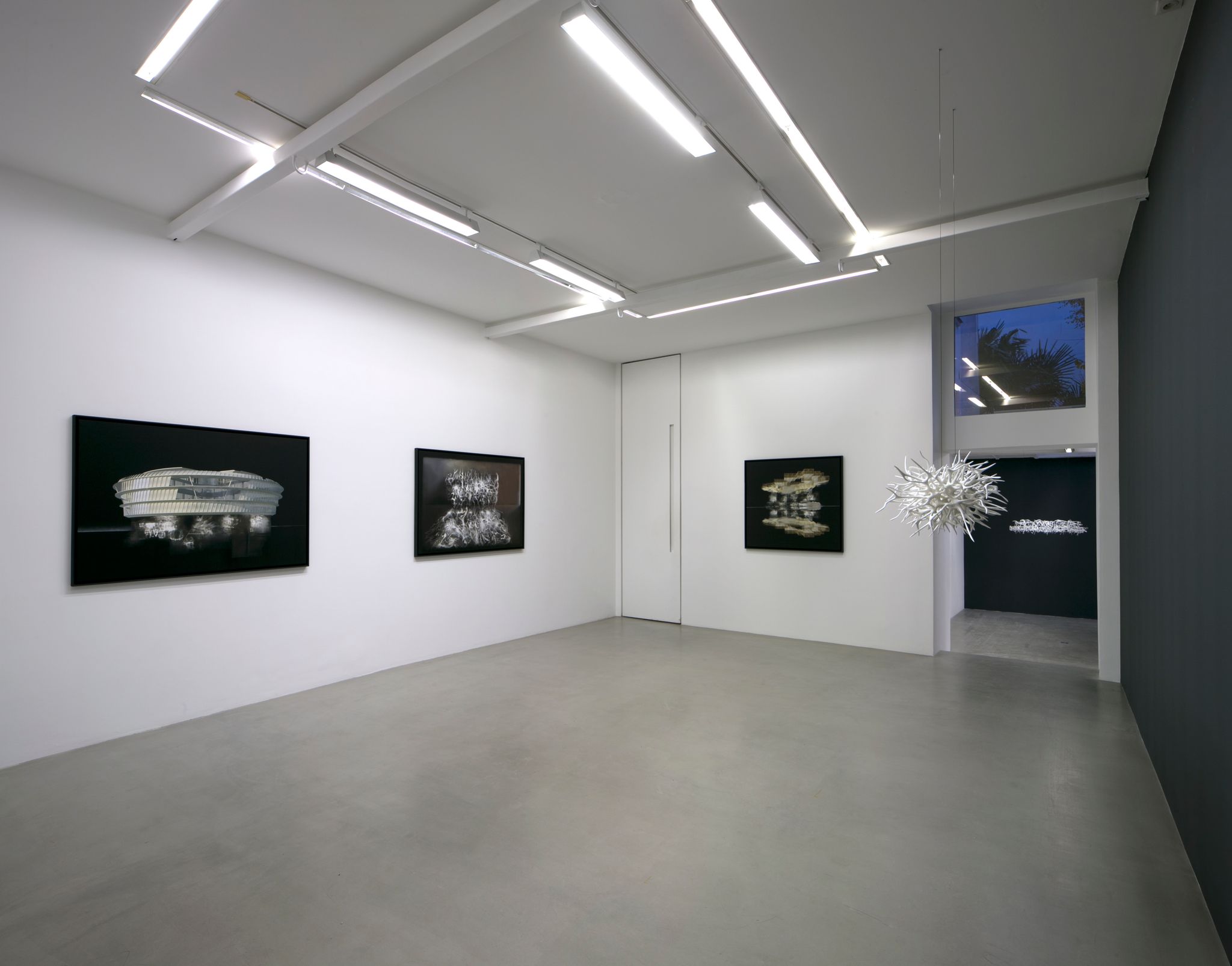
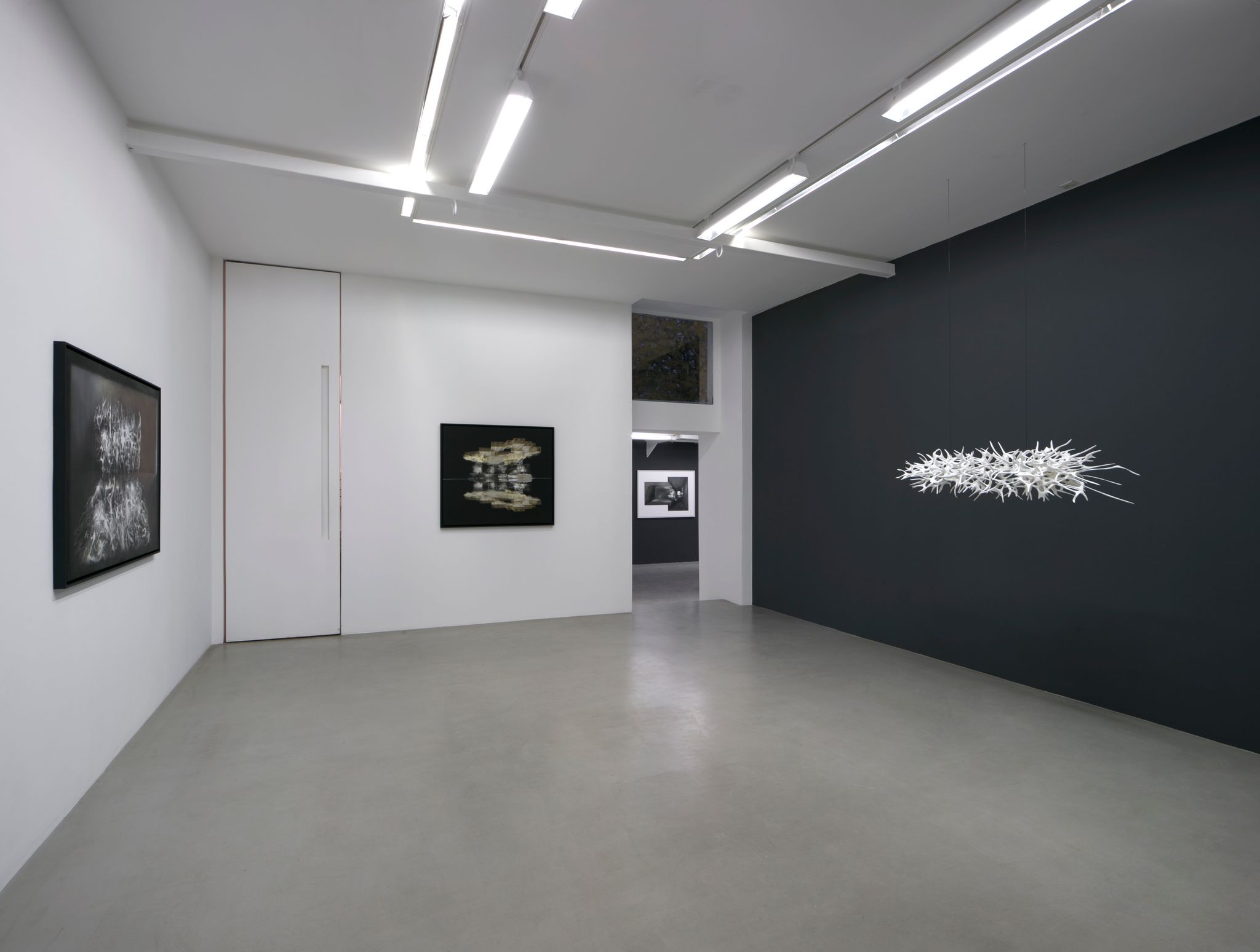
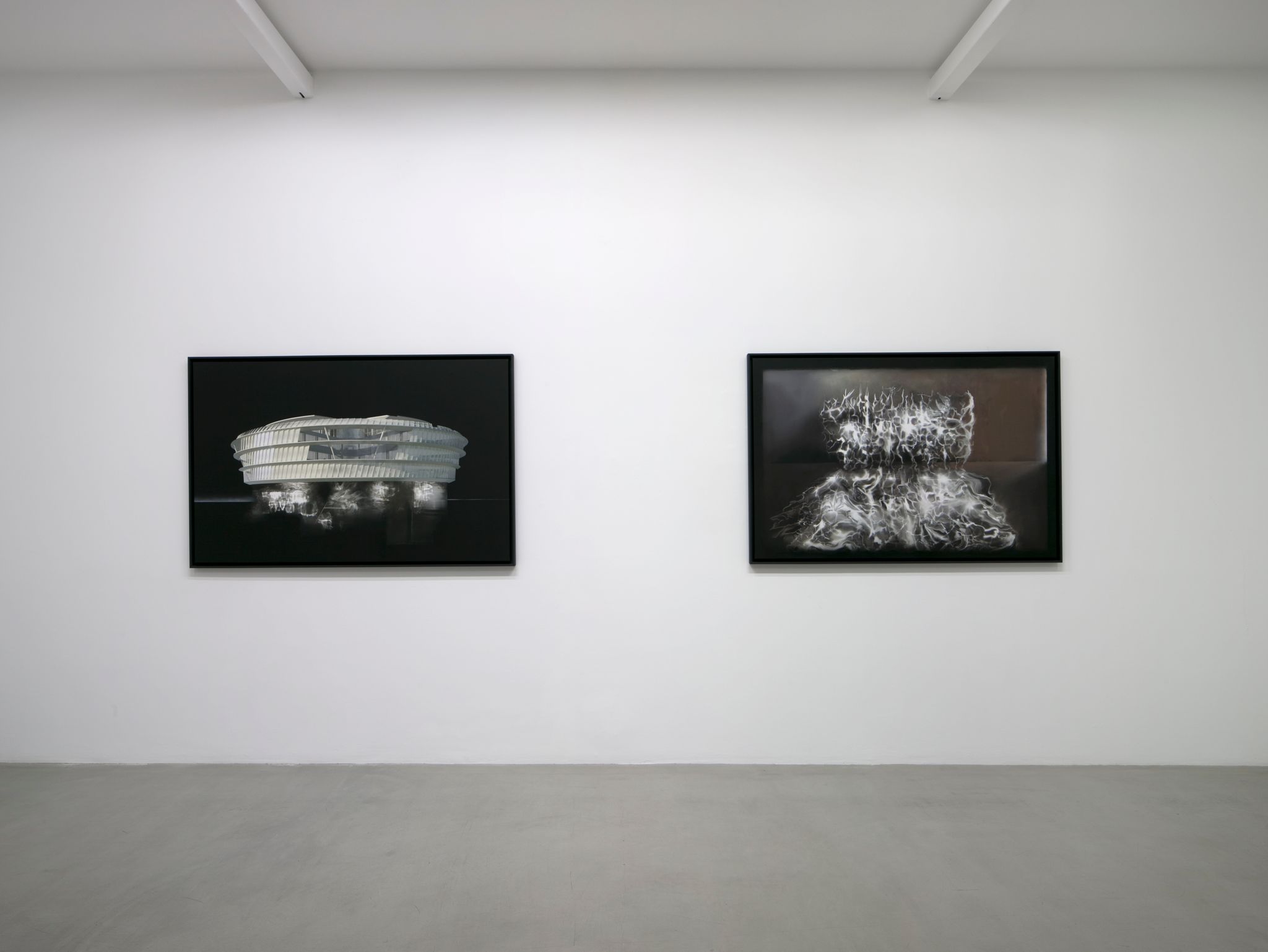
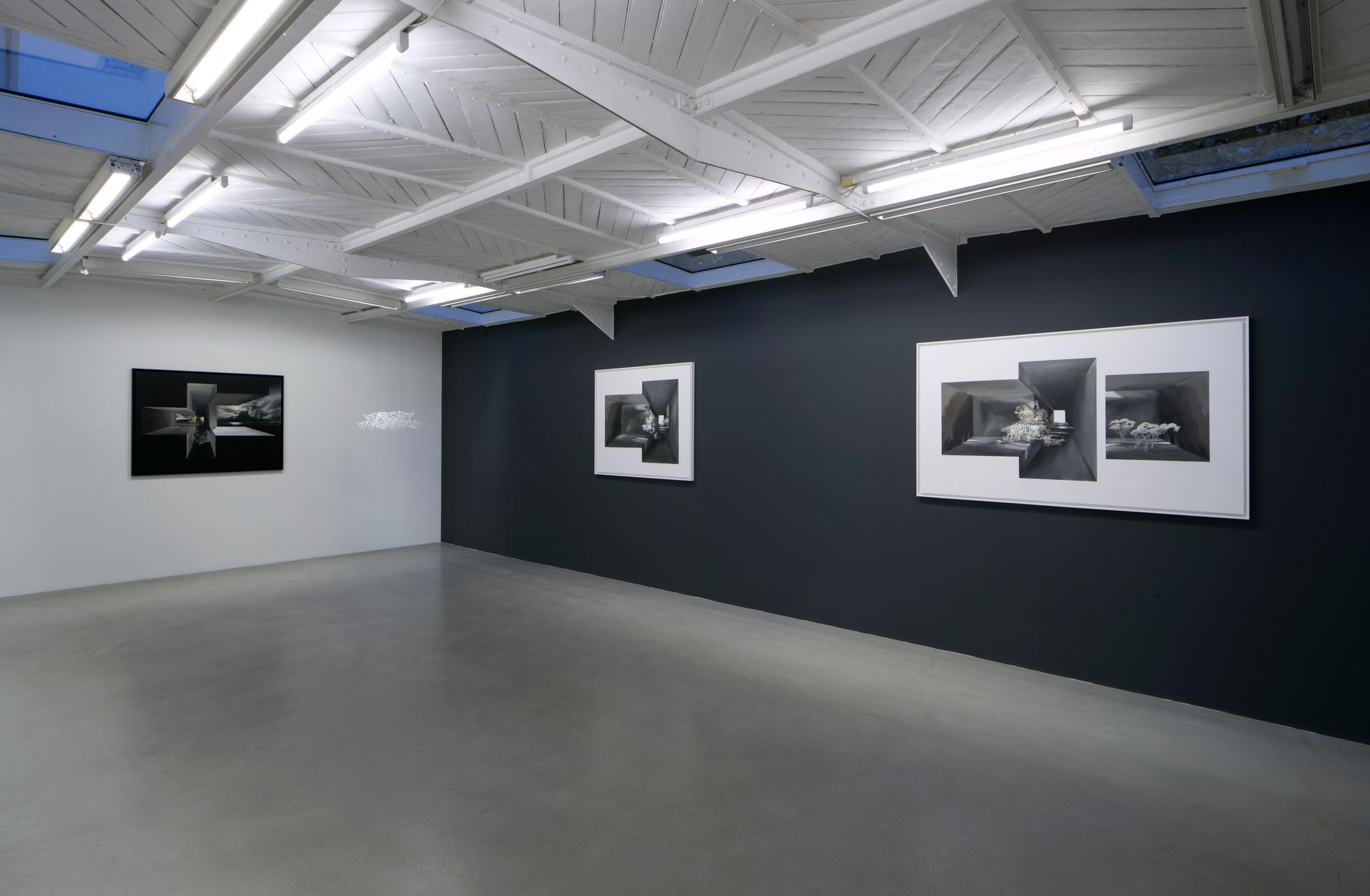
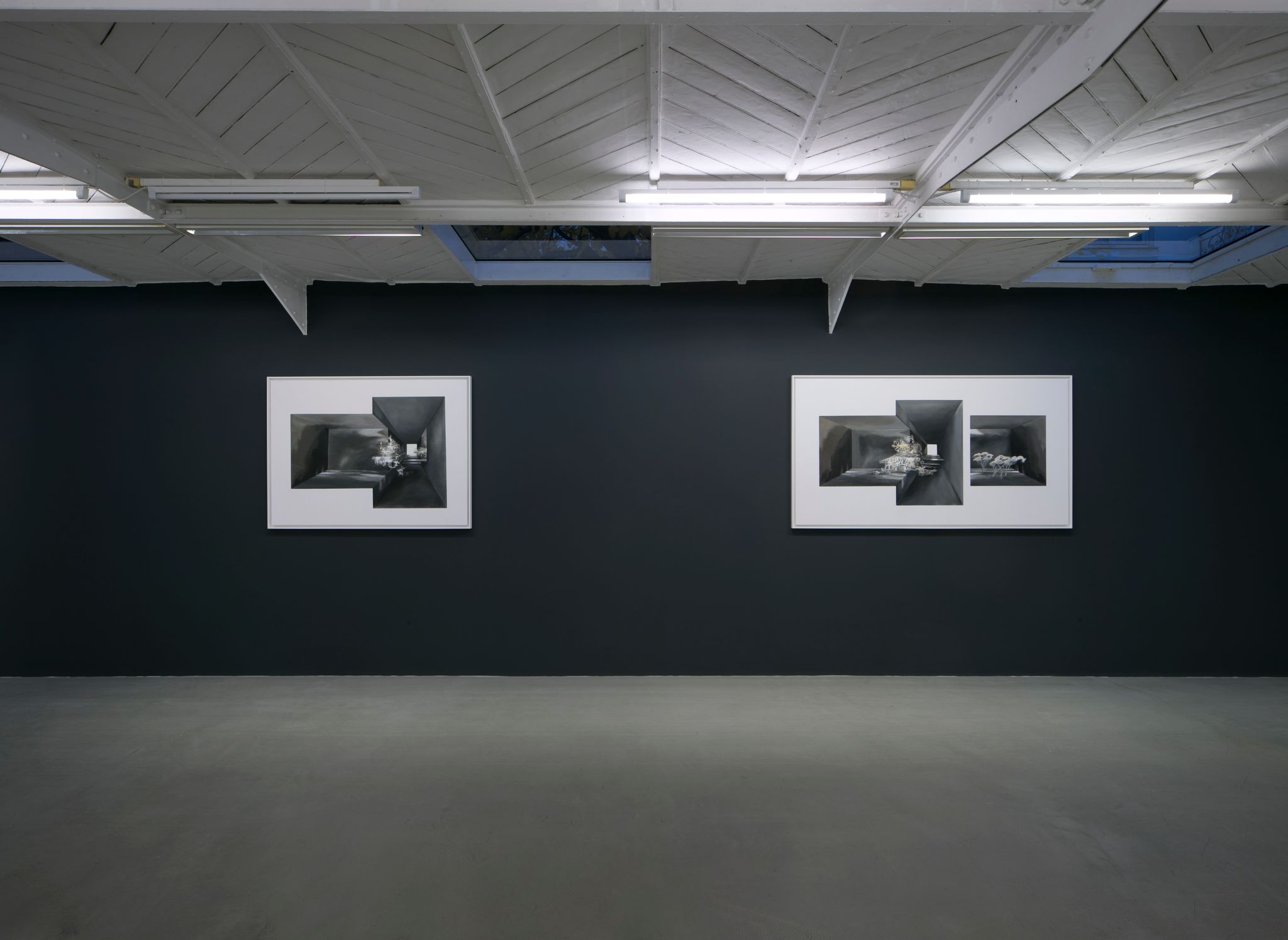
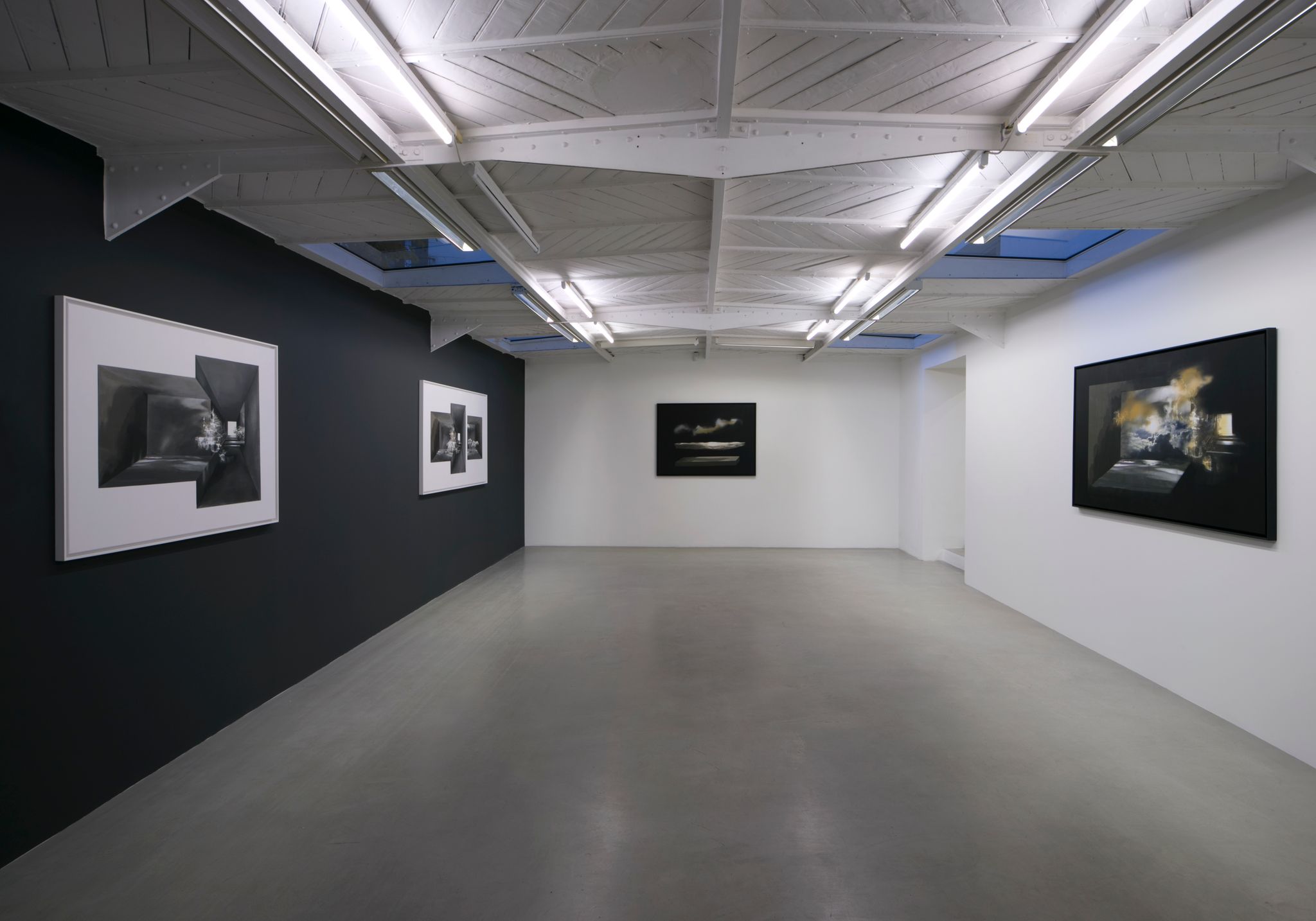
Christian de Portzamparc has always painted and drawn alongside his architectural projects. For him, it is a pure experience of space, pure because freed from the weight of material construction or installation. It is here that the architect’s ideas and obsessions become pictorial facts.
In the first room of the gallery can be seen three paintings based on an obsession to represent space and to play with the feeling of deepness that was forbidden in modern painting among Clement Greenberg.
Here, this system of descriptive geometry for representing space in two dimensions becomes a pictorial structure.
But the places described in infinite space are only visible if this space is traversed by light encountering matter—the gas particles, walls, dust, and solid objects that it illuminates. It is impossible for us to imagine what constitutes light on an infinitely small scale. Instead light has been symbolised here by a series of multidirectional networks that appear to be in movement. They have come from the distant time when Christian de Portzamparc would watch closely the phenomena of nocturnal projections and reflections, thinking about the turbulence of the photons that quantum physics presents as both wave and particle, but having no mass...
Jean-Hubert Martin [exhibition curator]:
As a lay observer, something that fascinates me is the question of how an architect conceives a space. Lots of people don’t know how to imagine space. Why are there people who are more gifted for this than others? Paradoxically, in your paintings, you fall between two stools. Because you’re neither creating a real space, with real architectural volume, nor are you in the tradition of modern painting where the dogma was to respect the flatness of the canvas and get beyond the representation of space. In some of your paintings you get the impression that space is unfolding towards infinity, with these indefinable bodies that don’t have any real solidity and seem to be in movement. They made me think of the famous theory of the fourth dimension, which was taken up by Malevich, and which involved adding movement to the three dimensions of line, plane, and volume. Couldn’t you say that this forms your link to the question of the creation of space?
Christian de Portzamparc: My drawings emerge out of precisely this question. How do we imagine and conceive space? Architecture is first of all a representation. It is a drawing before it has the possibility of becoming construction.
I’ve dedicated years of my life to imagining spaces in order to build them, but I’ve always drawn and painted on the side. It’s never had anything to do with my architectural commissions, but there’s an obvious relationship with the work of an architect. I don’t feel like I’m crossing over into another craft or another world when I move from one to the other. With painting and drawing, there’s the freedom of not having to wait five or ten years to see the result, whereas in architecture you need a lot of patience, hundreds of meetings, blueprints, calculations, conflicts, a constant energy.
When I began this series, there were two drawings representing the reference planes of descriptive geometry, the dihedral, which is the plane of the painting and the horizontal plane of projection with the line of the earth where they intersect. These are the universal, necessary references for defining a place in infinite space and for drawing the positions and forms of any object in plane, section, or elevation. Three-dimensional architecture requires this initial projection, where axonometry gives the illusive representation of perspective. My drawings often come out of this.
My watercolours in the 1970s were already based on this dihedral of the two reference planes defining a portion of infinite space in which I could then situate volumes, things. This is a representation of depth, which was off-limits in the pictorial modernism of the century following Matisse and Greenberg. This representation of space was already sought after by the painters in Pompeii and in the Middle Ages, then it was codified scientifically with the invention of perspective and reinvented with Cubism, or with universe of objects spatially by Matta for instance. In more recent drawings, there are formless, airy bodies and a metaphoric presence of light, which appears to our imagination as an enigma, alternately a wave and a sheaf of particles (photons).
J-H M: Can an architect also be an artist? Are there any great examples of this? I understand you wanted to be a painter rather than an architect at the beginning. Can you talk about these origins, say what the decisive turning point was for you?
C d P: I was passionate about painting, and about sculpture. I discovered the craft of architecture in a drawing for Le Corbusier’s Chandigarh project that I saw in a book by Jean Petit. It was then I realised that painting can also become a space you can walk around in, that it can be a place.
J-H M: On the other hand, you also draw a lot as an architect. Do you make lots of sketches?
C d P: In my book Les dessins et les jours published by Somogy, I start the text by saying, ‘architecture begins with a drawing.’ It was intended to be a bit of a provocation, because my generation was very influenced in the 1960s by semiology. In any case, in the 1970s, in some schools the students were not allowed to draw. They submitted a text for their diploma, with the idea that thought can only be transmitted through language. Drawing was gesture, and gesture couldn’t be intelligent.
J-H M : I remember in lectures and classes in architecture that I was going to back then, the teachers were criticising Le Corbusier because he drew. He was disparaged for being an artist and not an architect.
C d P: I feel like what I’m trying to draw are phenomena.
J-H M: Is this fluidity, this mistiness, a sort of representation of the void for you? Of what can’t be grasped, what can’t be brought within a set of limits?
C d P: That’s exactly what it is. You need a presence, something to make you think of the emptiness that is inviolate, which is absence.
These fluid bodies inhabit this void and give it an existence. This is what I enjoy imagining, representing. And then there’s the light that I draw when I catch reflections through glass, with this imaginative fascination for the statements of quantum physics. Light is both wave and particle! It’s impossible for us to imagine but I’m trying to show a sort of metaphor for it with these luminous networks that inhabit the space of the dihedral like clouds or gas.
J-H M: But with this little stage set that is always present with the dihedral, have you never been tempted to play with the space of a diorama? You could have imagined a semi-cylindrical volume in which you placed bodies and objects. Have you ever made installations?
C d P: It could happen one day, that’s clear. When Catherine Millet asked me to participate in an exhibition of ‘twelve artists in space’ that she was planning for Tokyo in about 1986, I was the only architect among artists like Daniel Buren. Maybe they expected an installation from me, but of a space and even of an object in movement. There’s an enigma in representation that I find fascinating. Drawings give you an entirely different experience to what installations do. Each time it’s an experience of the thought and imagination of space through which ideas are travelling without needing any other material to exist. With installations, I’d be back in architecture.
When I’m drawing, I go right to my goal, it’s a direct line, whereas in architecture the drawing is only the beginning of a collective adventure in construction, and I distrust it in this context. And if I built some of my drawings to the scale of a gallery room in order to bring about a physical, material production, I would have to choose materials, light fixtures, hundreds of metres of dimensions, clouds even, which would lead me into special effects or architecture, with all the associated costs, sites. The imagination is altogether more skillful and I’d say more efficient. I love the automatic, unconscious inventiveness of our imagination, which raises up all the landscapes that are evoked for us when we read a novel.
I like a painting if it invites you closer and pushes you back, if it gives itself the opportunity to be seen as an immense phenomenon or a tiny, intimate scene.
J-H M: But what’s interesting about that is that in fact, on the canvas, you represent a geometrical sculpture. Classically, in fine arts a distinction was made between the surface that was proper to painting and the volume that was proper to sculpture. And you place yourself in a position where you represent volumes that have something of science fiction about them.
To go back to what fascinates me as a lay observer: how does an architect conceive a space? There are lots of people who don’t know how to imagine space. Why are there people who are more gifted for this than others?
C d P: In architecture, I love it when I feel like I’ve really succeeded with a space. I can’t always explain it, but I catch up after the fact with the progression of a thought.
When I’m conceiving a building, I don’t necessarily need to formulate in language why I move things around in a maquette or draw a line on a screen. Sometimes I do formulate things because I have my team and it’s extremely productive to share, but as far as the heuristic of the project goes, there’s an essential part of it that can’t be written down. From that I draw the conclusion that there is a kind of thought that doesn’t pass through language.
We live according to the medium of language. We are language beings and at the same time we are space beings, which is a more archaic, fundamental medium, which constitutes us just as strongly. With space, it’s essential to feel the void, and that’s where language falters.
J-H M: It’s what’s known as visual thought, which is at work in art everywhere, and isn’t talked about enough. Do you still only use pencil?
C d P: No, for ten years now I’ve been drawing or ‘painting’ directly with a stylus on a tactile screen. I can quickly duplicate what I’ve done and explore variations of an idea, which would take days with a pencil. Jean-Charles Chaulet prints my drawings on canvas, I look for the dimension that is going to work, and sometimes I keep going. Then I touch up the pieces with a brush.
It’s a lot like certain moments in my work as an architect, where I work with drawing or maquettes, in small dimensions, slowly learning how to master what is going to happen in large scale in reality. But with the canvas, I’m interested in the distance of the gaze and not in the movement of the body within the building.
J-H M: How did you go about selecting the works for this series from amongst the huge mass of paintings you’ve produced over the decades?
C d P: This part of my production is varied, because unlike architecture, which responds to a programme, to a commission, for me drawing is without programme, without a calendar. I enjoyed this freedom, away from any sort of order or commission. I was not concerned with producing something coherent and I often didn’t think of an exhibition. It took me in many different directions, even if there are constants in the way space and light are represented.
Kamel Mennour came to see them every now and again. He noticed these constants and he soon became for me what a great editor is for a writer. He encouraged me to concentrate on certain directions. And rather than feeling muzzled, I went further, without any extra effort, with a coherence that ended up making sense.
—28 October 2019