
Alberto Giacometti
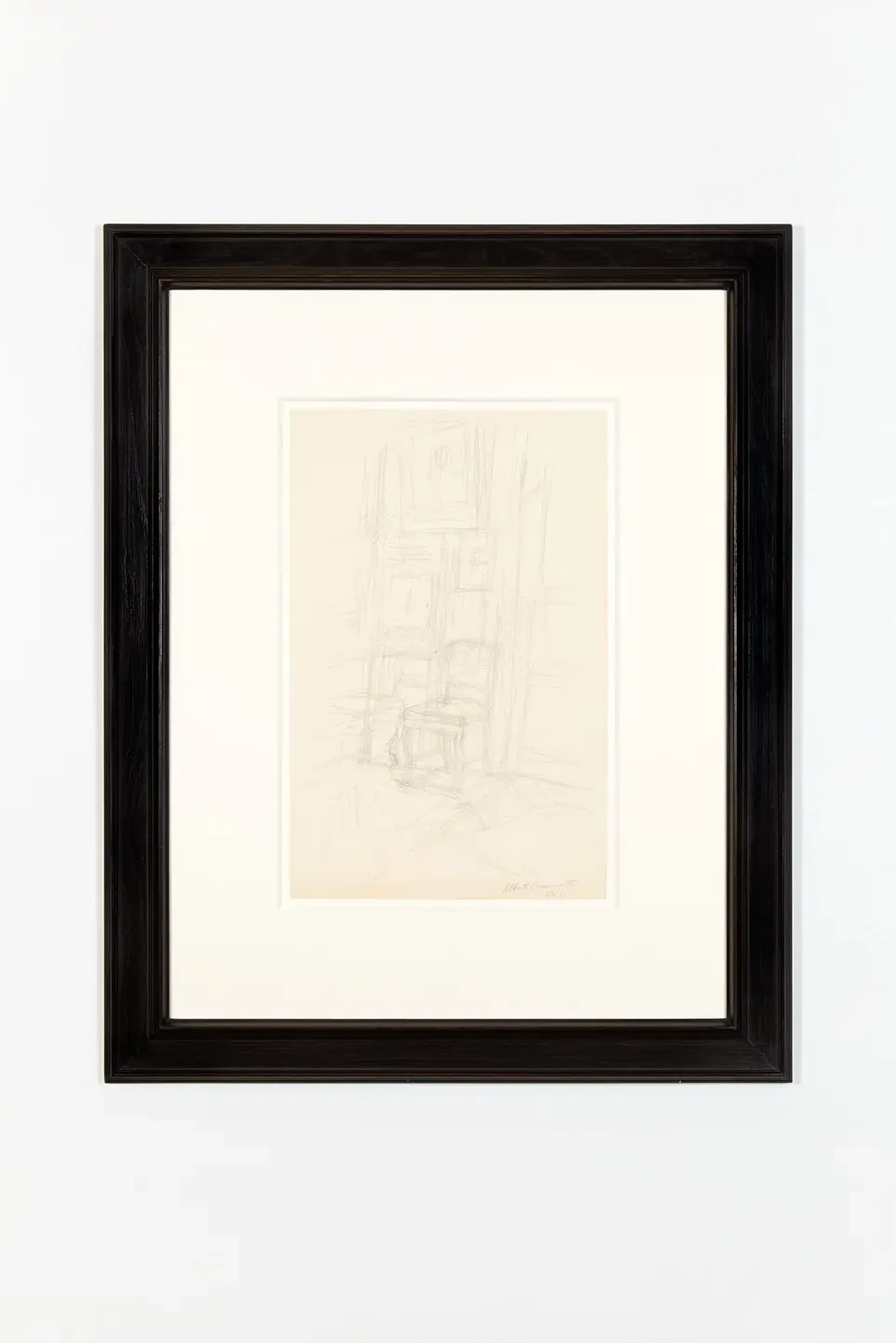
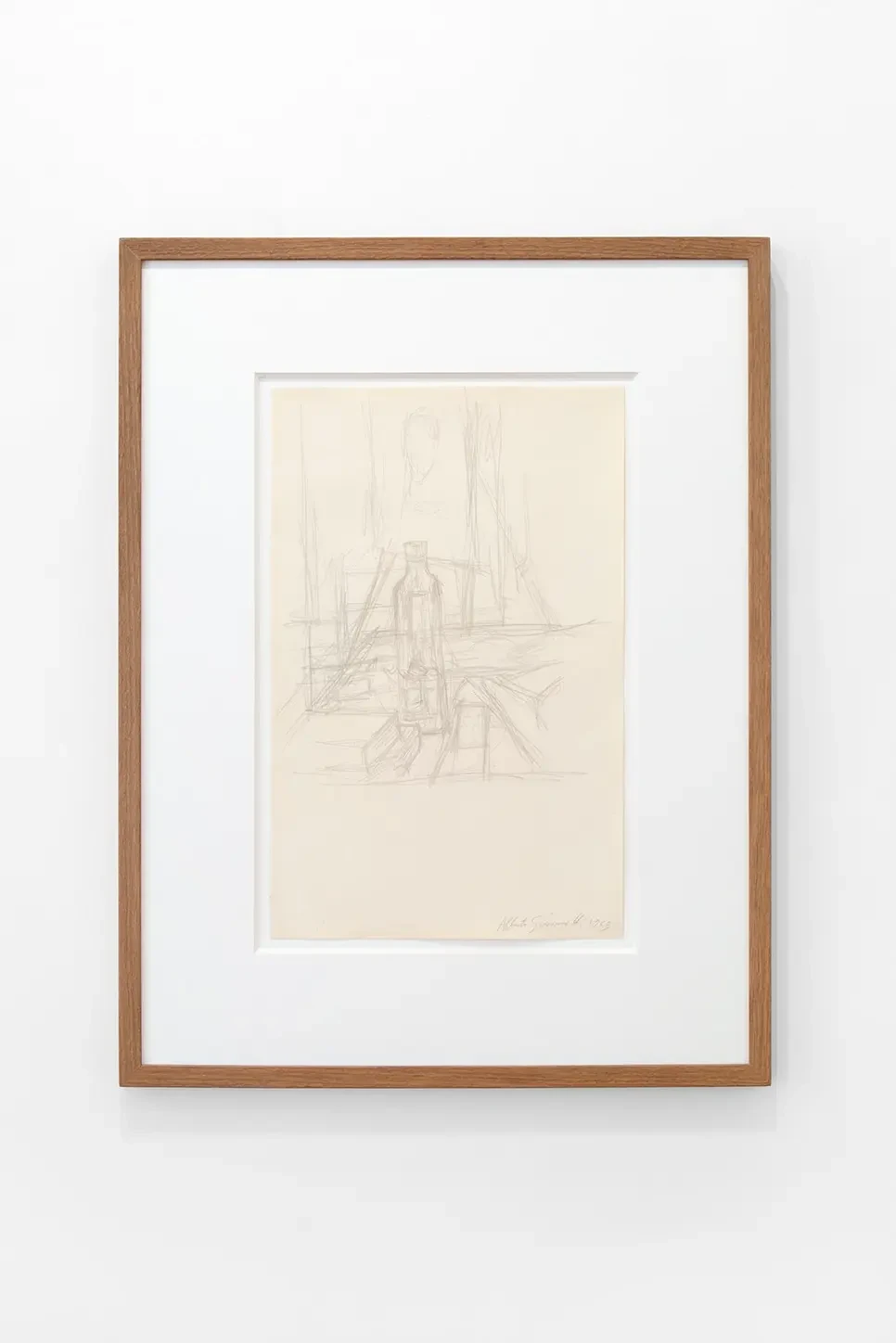
Nature morte avec bouteille, 1963
Artwork
Alberto Giacometti
Nature morte avec bouteille, 1963
Crayon sur papier / Pencil on paper
49.5 x 31.5 cm (19 1/2 x 12 3/8 in.) Encadré / Framed: 71.5 x 52.5 cm (28 1/8 x 20 5/8 in.)
Price on request
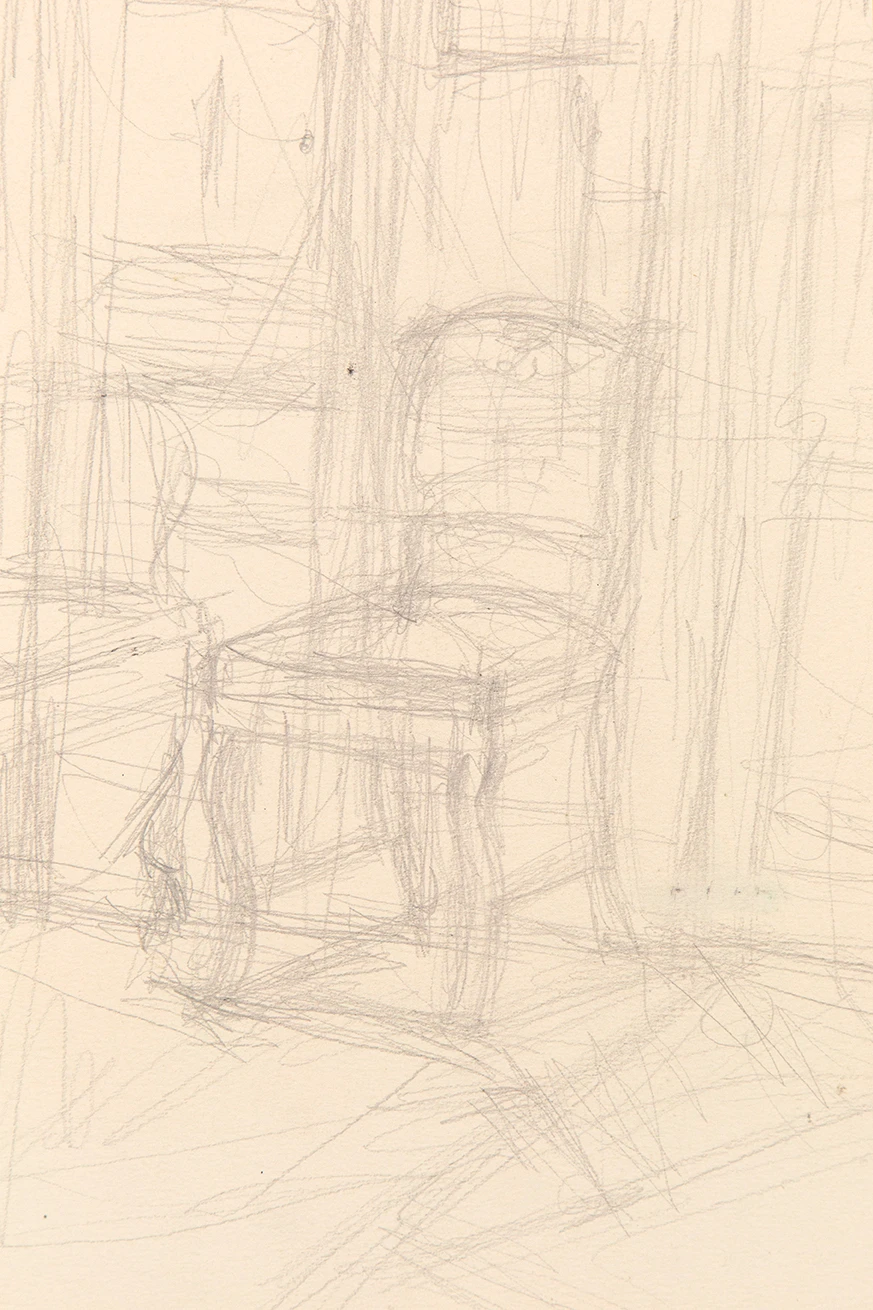
Nature morte avec bouteille [still life with bottle] is a shimmering work of draughtsmanship by one of the most
important European artists of the twentieth century. The work depicts a table in the artist’s studio with a
bottle and a pile of books. Behind the table stands an easel with a painting on it. Like his contemporary
Francis Bacon, Alberto Giacometti forged a highly individual reputation founded on a small number of
original artistic innovations. His personal style of draughtsmanship was characterised by an accumulation of
rapidly repeated markings in soft pencil. Rather than treat his subjects with stylised definition, the
accumulated markings suggest with great subtlety the interaction between a three-dimensional object and
the light which falls upon it. Giacometti’s sensibility for the plasticity of objects, their volume and shape, was
highly refined and developed from his experience as a sculptor. Surfaces in these drawings are fluid not
solid, yet the weight and superficial appearance of the subject is registered with precision in each finished
work. The strength of outlines in the drawing are carefully modulated to suggest the relative proximity of
objects, with stronger markings evoking those objects close at hand.
Giacometti depicted still-life subjects in paintings and drawings from the late 1930s until the end of his life.
These works are inseparable from his depictions of the studio interior which he began making at the same
period. His living and working spaces assumed a position of overwhelming importance in his art as he
socialised less and increasingly devoted himself to his art. The confines of his life, studied with growing
intensity, became concurrently more important in his practice. As he grew older the range of his subjectmatter
narrowed until the few remaining topics – portraits of his family and depictions of a familiar room –
attained a profound visual intensity. An empty chair or the sculptures in his studio were studied with the same
intensity as portraits of his family members. One elaborately decorated hanging lamp was of particular
interest in 1963 (fig. 1), as were the same few high-shouldered, short-necked bottles apparent in Nature
morte avec bouteille. Similar bottles appeared in a painting of 1956, known either as Nature morte avec des
bouteilles or Les Bouteilles, and many bottles were kept on a desk in his Paris studio, as is clear from several
photographs taken in the 1950s and 1960s (fig. 2).
Nature morte avec bouteille was made at a time of acute personal difficulty for the artist. In February 1963, he
underwent an operation for stomach cancer. He was subsequently unable to work for several months
afterwards, except for making drawings. It is possible that this drawing was one of those which Giacometti
made after the operation. His convalescence began at home in Paris and continued at Stampa, the Swiss
village of his birth, where his mother still lived and where he maintained a studio.1 (His mother died in January
the following year.) Also in this period, Giacometti made a series of five drawings depicting a hotel room
(Chambre d’hôtel). The same table and chairs by the same window are re-iterated from different
perspectives, under different light and with different contents filling the table.
Each of Giacometti’s pencil drawings had an integrity of subject and medium: a small piece of the world is
captured in a sonorous act of representation. He did not make pencil drawings in preparation for his paintings and sculptures. Writing in 1984, Bernard Lamarche-Vadel described how Giacometti made increasing use of the rubber towards the end of his life, ‘not to correct mistakes but to infringe on form, which, corrected or not, seemed to him an external approach both to the object and to himself.’2 The suggestion is that Giacometti sought to re-make the objects themselves in his drawing, as if his pencil markings were giving expression to some pre-existing presence. Furthermore, the repetition of outlines served ’to identify in an unfolding process the emergence of a contour.’3 The final appearance of the drawing is therefore inseparable from the self-evident process of its making. Though his subject-matter was elementary, being derived from the interiors where he lived and worked, he used a soulful investigation of form to invest these light-infused spaces with great visual power.
A label attached to the back of this drawing shows that it was handled by Noah Goldowsky (1909–1978), a
Belarussian emigré who established himself as an art dealer in New York. Goldowsky was originally in
partnership with another dealer Bud C. Holland in the 1950s but was bought out in 1961. From that time, he
established his own independent commercial gallery, moving to premises at 25 East 83rd Street and
remaining in business until the mid-1970s. Goldowsky specialised in European modernist art and held
various exhibitions of work by Auguste Herbin, Piet Mondrian, Man Ray and others.
Despite his ill health, the end of Giacometti’s career was marked by accolades and widespread recognition.
In 1962, he won the Grand Prix at the Venice Biennale. Several retrospectives of his work were organised in
the 1960s, including those at Kunsthaus Zurich in 1962/63 and Galerie Beyeler in 1963. As his energy for
sculpture ebbed, his draughtsmanship flowed and he produced works such as Nature morte avec bouteille
which speak of his immediate environment with intimacy and seemingly limitless fascination. This work
belongs to a significant theme in his oeuvre and is a fine example of his late style of draughtsmanship.
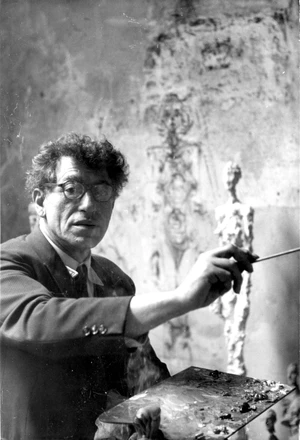
Alberto Giacometti
Died in 1966 in Chur, Switzerland